
I’ve been asked to do an intensive morning at the prefectural university that will have a small group of students from an exchange university in Thailand on a short term visit, some prefectural high school students and some of the university students. So I thought, how about monkeys? The class will be more encouraging students to think about the relationships, so I won’t be teaching any of this, it’s just sort of a frame for the activities, but I’ll subject all of you to it.
I’m going to compare Son Goku (known as Sun Wukong (孫悟空) in China), also known as the Monkey King and Hanuman, the Monkey Warrior originally from the Sanskrit epic poem Ramayana which is found in the Thai version of the tale, called the Ramakien. Son Wukong is a secondary protagonist in Journey to the West, a 16th century Chinese novel that found its way to Japan, but as is often the case with secondary protagonists, Sun Wukong ends up being the main character when translated/reworked by others because they are often given more room for character traits and growth. This is particularly true for Son Goku, who has divine ancestry, but is not a god. After various attempts of the gods to appease him, he eventually ends up stirring so much shit that Buddha has to trap him in a mountain for 500 years. When the primary protagonist, a monk named Tang Sanzang, appears on a pilgrimage, Son Wukong is released and becomes his disciple/travel buddy.
Son Wukong draws on the archetype of trickster god, so he could be compared to Loki, Coyote/Raven for many native American tribes, Maui, and Hermes and I will have to resist temptation to go off on that with the students. However, it does occur to me that Abrahamic religions could really use a trickster figure, and the absence of one is probably one reason the world is currently such a dumpster fire.
Hanuman, on the other hand, comes to Thai via India, where he is the archetype of a noble warrior. He is originally a Hindu deity and is the defender of Rama, who Hanuman helps fight the demon king Ravana to rescue Rama’s wife, Sitaand. (in this video, Rama is the blue dude and the weapon Hanuman has a gada, an Indian mace) If you watch any Indian films, I suspect he is the model for the kind of Indian action hero who is never flustered (like this prime example)
When Hanuman was brought into Thailand, he started to acquire more trickster like characteristics, though nothing to the level of Sun Wukong. The Indian version was a total celibate, with absolute self control, but the Thai version, he woos and marries multiple women (apparently, monastic abnegation is not really a Thai thing) as well as being clever and and boastful. It’s possible that the Thai Hanuman is the bridge between the Indian Hanuman and the Chinese/Japanese Sun Wukong/Son Goku, given that their ‘superpowers’ are the same, including size/shape shifting and transport. Hanuman can leap from India to Sri Lanka while Su Wukong does a somersault cloud jump to travel long distances (in fact, one of the ways Sun Wukong is subdued by Buddha is that he boasts that he can jump out of Buddha’s hand. He does this and arrives at the edge of the universe where he finds 5 pink pillars holding up the sky. To let everyone know that he was there, he writes his name on the middle one and then urinates on it. He then jumps back to Buddha’s palm. After he demands his prize, Buddha holds up his hand and Su Wukong sees his name that he has written on that pink pillar visible on Buddha’s middle finger.) They also wield similar weapons and both are loyal to their master.
I’m not too sure how much the Thai students will know/remember about Hanuman (the Ramakien is in the Thai curriculum) but I suspect a lot. The Japanese have to do parts of Journey to the West as a kanbun (a rather strange reading method where students take a classical Chinese text and—without changing the written characters—add special diacritical marks to mentally rearrange the words into Japanese grammar and read it aloud in Japanese), however, I’m not sure how well they paid attention, but fortunately, there is a manga that drew its inspiration from Son Goku, which is named Dragonball.
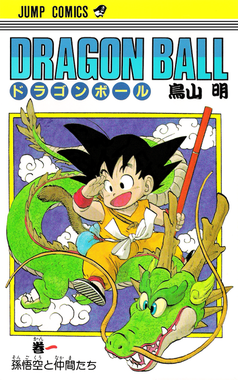
Dragonball is what is termed as Shonen (Young boys) manga, a genre arising in the 80s and 90s. One magazine, calling itself Weekly Shonen Jump after this target audience, used to sell 5 to 6 million copies a week. Other stories that you may have heard of from this time are Slam Dunk and Sailor Moon. Toei studios did the animated version of Dragonball, and it seems to have been hugely popular across Southeast Asia, so it is likely that the visiting Thai students are going to be familiar with the character. The story is a little before the Japanese students time, but I’m going to have copies of the volume of the manga so the Japanese students can explain some of the points.
The author of Dragonball, Akira Toriyama, kept the same name (Son Goku) (if you read the Japanese at the bottom, it says Son Goku and Friends) but made him an 11-year old living in the wilderness, powerful but very naive. So there is a lot of fun comparisons that I hope I will be able to leverage.
Almost all of this will be out of sight of the students, but I’m hoping that they will be able to use their individual knowledge of the characters to first compare and contrast Hanuman and Son Goku and then to talk about how Toriyama changed the character of Son Goku from an clever god-like creature to an 11 year old who had been adopted and raised by his now deceased grandfather and now lives in isolation, sort of like Tarzan. I don’t know how deep I will go, (for example, Son Goku is convinced to go on a quest for the Seven Dragonballs by a character named Bulma, who play the same role as the monk Tang Sanzang, but played as a genius hi-tech and rebellious teen and the contrast between Bulma and Tan Sanzang is pretty fascinating) but whatever I do, it’ll be fun, at least for me.
It’s not for another 2 months, so I’m going through Dragonball and Journey to the West and thinking of other activities that can draw on this. The big problem will probably be similar the warning given to aspiring jazzers, which is “Don’t play everything you know in the first chorus”. If this were a course, I’d have the students all read Gene Luen Yang’s graphic novel American Born Chinese, which is a clever retelling of Journey to the West, but there is not enough time, though I can’t recommend that book enough as it touches on many of the questions of identity and assimilation that come up here.
Anyway, a post with nothing to do with politics, so feel free to chat about anything you’d like! (though I’d love to hear any experiences with anime or manga folks have had)
I guy I know is on Facebook under the name Hanuman Sun Wukong. That’s all I got.
Invite him over! I’m sure he’s got a story to tell!
Or you can consider that the purpose behind cultural relativism is to provide a way for the ethnographer to describe a foreign (to him) culture and describe how it works. From the viewpoint of the members of that culture, without injecting into the description a lot of discussion about the way a member of his own culture would react if living in that culture (rather than just visiting).
Ideally, ethnographers from the US or China or Japan or India, describing the culture of a native group in the Amazon, would produce very similar descriptions. In reality, it’s impossible to successfully set aside all of your cultural baggage, no matter how hard you try. If nothing else, your attention tends to be drawn to the parts of the culture which are most different from your own. But it is possible, and useful, to reduce the impact of the observer’s culture on the description you produce.
But even if a particular culture doesn’t do much with legal formalities, it will still have norms about marriage and socially enforce them.
They have norms about how people partner or group up. Those generally flow to specific examples, like male/female couples, who comprise the majority, and those norms are kept those in place with social enforcement. But as soon as you say ‘marriage’, you kind of lose me in making some sort of universal argument.
I mean, you have the word kekkon(結婚)in Japan, which roughly corresponds to marriage and is what you say to explain to your friends. Marriage, right? But if you fill out a government document, it is kon’in (婚姻) which is more meaning affiliation, especially between two houses. In fact, in the Heian era, marriage was matrilocal, with the man _visiting_ the wife at her mother’s house, which gives interesting thoughts what ‘meeting the family’ means. And if the husband didn’t visit within 3 months, the couple was considered divorced. As Mr Spock might say, it is marriage, but not as we know it.
That system took 500 years to disappear, in part because it made more sense to move the wife to the samurai husband’s (fortified) estate and primogeniture was necessary to prevent a family’s lands from being divided, weakening military power. This is when Neo-confucianism got into it and eventually, it was codified that the eldest male of the family had total control over everyone in the household and a marriage could only take place if he approved it. But you still have traces of that matrilocal system, like muko-iri, 婿入り where the husband is adopted by the wife’s family.
We can argue whether these sorts of differences are enough to undermine a term of marriage, but regardless, I’d avoid making claims about the universality of marriage until you specifically define what you mean.
OK, I can take a shot at that.
Marriage: a term signifying that two (or more**) individuals have taken a legal and/or ceremonial step to form a new, publicly acknnowledged, social unit that includes both of them. That is, they did not just start cohabitating. They are not just “friends with benefits”. There was some public action to establish the new unit. And, generally, some kind of legal and/or ceremonial action is required to later dissolve the joint unit — stipulating that dissolution is, in some cultures, not an option.
What kind of legal action or ceremony is used varies widely, of course. But there is some kind of public acknowledgement that a new social unit now exists.
Hope that helps.
** Until very recently, either one man and one or more women, or one woman and one or more men. With everyone assumed, at least for social purposes, to be having sex primarily if not exclusively with those of the opposite sex.
Until the Council of Trent cohabitation did a legal marriage make (marriage by consent). Even the private consent (He: “you are my wife” She: “Yes”), the matrimonium clandestinum, was valid as far as the Church was concerned. The Council changed that and required the priest and the witnesses. Protestants did not follow necessarily (Luther thought the fathers had veto power). State and Church depending on location insist to this day on either mutual non-recognition or one requires one to precede the other. And let’s not even go to what is or was considered a divorce even limited to European cultures.
I understand that it’s desirable to describe a culture without judging it. But I reject any suggestion that no culture is inferior to another.
For example, a culture which enables slavery is worse than one which forbids it.
A proof would require some axiomatic statements about what is desirable. In the end, one has to make a moral judgment about those axioms. I’m entirely willing to do that.
I’m not really sure how marriage is something you want to take as something that, I don’t know, argues against cultural relativism? There are a lot of things to pick at, like the oscillation between legal terms and social naming (shacking up, friends with benefits), but the fact that you name it suggests that there is some public recognition of the fact.There is not a ‘who is shacking up with whom’ column in the NYTimes, but within that person’s social sphere, there must be something that had to be named.
Again, speaking of Japan, almost everyone gets married civilly and there is no requirement for a ceremony, an officiant, or any kind of celebration to make it official and over half of the people do what is called a nashi-kon (no wedding marriage). So your definition seems a bit ethnocentric, at least where Japanese are concerned.
To understand ‘marriage’, you have to look at the totality of the culture, which seems to require some sort of cultural relativism in order to not fall into false comparisons.
Again, speaking of Japan, almost everyone gets married civilly and there is no requirement for a ceremony, an officiant, or any kind of celebration to make it official
but they tell their friends and family, right?
because even without the big party thing or the religious aspect, simply announcing to other people that you are a couple is a big part of the event.
I took wj to be describing his understanding of a rather specific academic approach to a subject rather than telling everyone how to think about it. There are, I would imagine, reasons why that particular approach is preferred – guardrails that don’t necessarily apply outside the discipline because the goals are often different. At least that’s my distillation of some of the comments.
I’m having a really bad
daythread for explaining myself. 🙁I would say that marriage is an example of cultural relativism. While, at least in my view, every culture has an institution of marriage, the forms it takes, the ceremonies involved (if any), etc. vary widely. Cultural relativism says that those forms are equally valid.
Suppose your culture, like American culture, includes civil marriage. Another culture requires a religious ceremony for a marriage. Does the second culture get to say that anyone with a civil marriage in the first culture is immoral because they are “living in sin”? After all, they didn’t get the reqiured-by-the-second-culture religious stamp of approval. Cultural relativism says no.
Gandhi’s famous first campaign in South Africa resulted from the asinine idea of the authorities to only recognize Anglican ministered marriages, effectively declaring any other invalid and the children thereof as illegitimate. Muslims in particular were not happy.
Reminds me of US religious Right’s ideas to make church attendance and religious education in their narrow interpretation of Christianity mandatory for everyone, in particular non-Christians while claiming that no one’s freedom was infringed by that since everyone was free to leave the country.
Or the idea of Austrian ethno-nationalists to require yearly public consumption of national dishes (that by pure chance included pork).
Not in front of the emperor’s statue though, afaik.
For some “cultures”, meddling in and infringing on other cultures is a core tenet.
Btw, the traditional pork ban in Judaism and Islam was simply common sense, as were several other food-related taboos
For example, a culture which enables slavery is worse than one which forbids it.
A proof would require some axiomatic statements about what is desirable. In the end, one has to make a moral judgment about those axioms. I’m entirely willing to do that.
I agree wholeheartedly. Once, when I was young and foolish, I was prepared to take the other line, but the issue which changed it was FGM (female genital mutilation). The fact that many older women in the relevant societies supported it became irrelevant to me when I heard the horrifying testimonies of women who had suffered appalling (fully intended) effects, and from girls and women who had either suffered terribly (you don’t hear from the ones who die), or only just got away/out of the relevant countries in time.
For the avoidance of all doubt, I am also against male circumcision unless absolutely medically neccessary.
Been thinking about this and I’m hard pressed to come up with a horrible behavior that hasn’t at some point been acceptable to some community somewhere.
It seems that if you can categorize some identifiable group as “those other people who aren’t like us”, you can find a way to do whatever your imgination can summon up.
It’s depressing
Battening down the hatches for the possibly two typhoons on their way, I’ve gotten quite confused about what we are arguing about. Looking back, my problem is that wj’s first comment seemed to take in the common conservative trope of cultural relativism = fuzzy liberal thinking of anything goes. nous pointed out that for undergraduates, you often have to pound into their heads the fact that _everyone_ carries a lot of prejudices and it is hard work separating oneself from them. Getting them over that hurdle is job 1, but some people take it (or possibly more accurately lampoon it) as all there is.
As Russell notes, humans have a long history of doing shitty stuff, so making anyone doing that the villain is probably going to preserve, and possibly enlarge blind spots. I’m sure I’m not alone in wondering what people in the future are going to make of the things that I do and think ‘wtf were they thinking?’
my bet:
most will use their own standards and confidently say we did it all wrong because we were stupid and evil, while blissfully ignoring the stuff they’re fucking up for their future generations to suffer through. but some will understand how large-scale politics work and realize that there’s no chance we could have done it better.
just like every generation does.
I’m often amused when learning of past controversies that were OF EXTREME IMPORTANCE at the time, but are now nearly forgotten.
Except as joke punch-lines, like “Free Silver”, or “Fifty-Four-Forty or Fight!”, although Trump seems to be bringing back the oldies.
I look forward to a time, hopefully in the not too distant future, when women will have full, conscious control of their fertility, without needing any external intervention, and the RWNJ Fundies can fuck right off about abortion.
Maybe this is me explaining something everyone knows, but The Wizard of Oz is supposed to be an allegory for ‘free Silver’. The Yellow Brick Road is the restrictive gold standard and Dorothy’s shoes were changed from silver to ruby because MGM wanted to take advantage of Technicolor. The 4 characters travelling with Dorothy are supposed to be allegories (scarecrow is farmers, the lion is Williams Jennings Bryant, the tin man is industrial workers and the Wizard is supposed to be the US president, who appears to have power but really doesn’t) and The Emerald City is supposed to be Wash DC. And my fave, Toto is supposed to represent Prohibitionists (tee TOTOller)
If you want to read more
https://www.independent.org/pdf/tir/tir_09_3_6_taylor.pdf
If you want to read more
Link to the libertarian journal The Independent Review. Is this a first? 🙂
lj: Thanks! I did NOT know those allegorical connections. Re-watching TWOZ will be a lot more interesting now.
If you sync it up with Dark Side of the Moon it will get that much deeper when Money comes on.
Charles, if libertarians confined their discussions to culture and film interpretation, I’d definitely be happier.