
My mother had three brothers. They came up in the Richmond Hill area of Queens, near the Jamaica rail yard. The brothers all married women from the neighborhood, and they were a very lively crew. Here they are in my grandparent’s living room, probably late 1940’s.
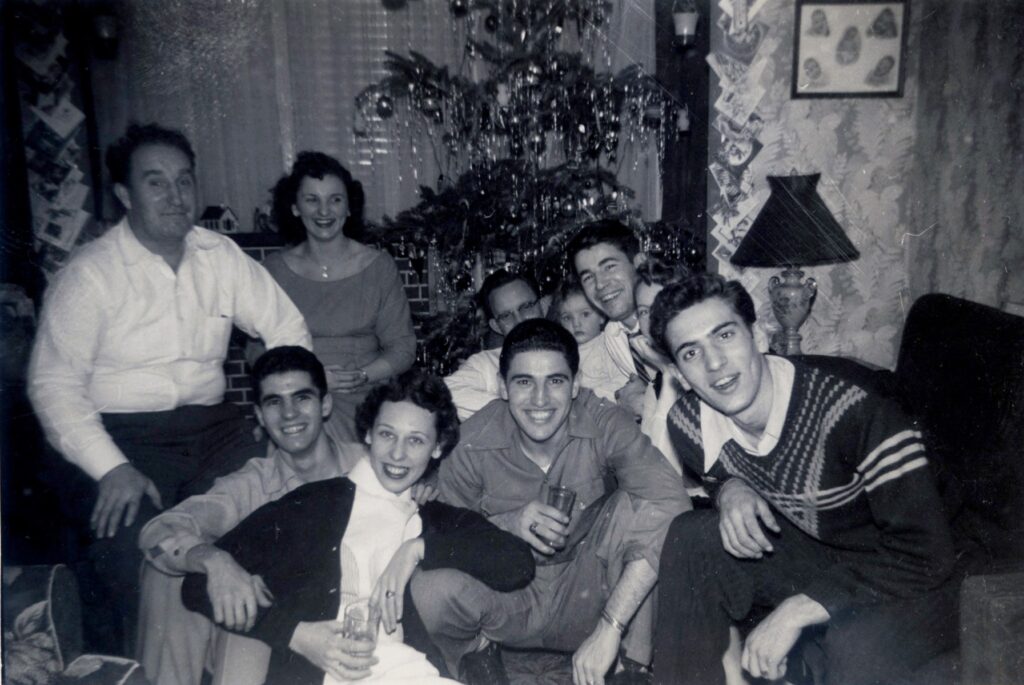
They could make a game out of anything, and would make a party out of nothing at the drop of a hat. They all had big-ish families – 4 or 5 kids – and at family outings me and my tribe of a dozen-and-a-half cousins would run around like a bunch of wild monkeys.
It was a lot of fun.
Charlie, my mother’s youngest brother and my godfather, passed on Friday at age 90. That’s Charlie on the right, kneeling in the sweater. He was the last of them to go. It’s the end of an era, the closing of a generational door.
All of this has me reflecting, oddly enough, on the dilemma of people and politics.
Charlie, along with my uncle Tucky, were NYC firemen. They risked their own lives on a regular basis, and saved a number of other lives. Not in the abstract, but truly and concretely, hands on. Charlie had a very interesting mind, and was curious about any and everything – world history, family history, heirloom apples, Tin Pan Alley songs from the 20’s, old cars, whatever.
He and my aunt Pat – herself the daughter of honest-to-god Fenians, and whose own mother used to smuggle ammunition in the baby carriage – took their kids on a family trip to the Southwest. They were disturbed by the condition of indigenous people on the rez, and so adopted my Apache cousin Peter and my Hopi cousin Tara. When the US left Vietnam, triggering the “boat people” crisis, they adopted my Vietnamese cousin PJ.
They had a friend who ran a shelter for abandoned kids in Nicaragua and they made many trips there with money and goods, at a time when it was not all that safe to go there. In the early days of the AIDs crisis, Pat used to go to Manhattan to care for women with AIDs at a time when nobody would go near them.
Good people.
Charlie was also very much an arch-conservative, politically. Loved Reagan, loved the Bushes, especially W. I never really discussed it with him, but I’m sure from comments and FB posts that he supported Trump. Back in the day, he was a Bircher. And when I say he was a Bircher, I mean he was the head of his local chapter of the John Birch Society. He tried to recruit my dad, but for various reasons dad steered clear.
I was talking with my wife about all of this last night, and she asked “How could you be that kind of person, and have that kind of politics?”. How can you be the kind of person who responds to people in need by, literally, taking them into your family and/or traveling to dangerous places to help them, but not see the tangible harm done by the people and policies you support?
I can’t really get my head around it, TBH. And I’m sure we all know people like my aunt and uncle. Lovely people with bizarre and harmful politics.
We’re living in a remarkably hateful moment. “Polarization” doesn’t really capture the flavor of it – it’s not just differences of opinion, it’s all that plus anger and distrust and animosity. I’m as prone to it as anyone else – I see a Trump bumper sticker or the famous red hat and my hackles go up, immediately. I assume that this is a person I cannot trust or respect.
And not without reason.
Some of those people really do seem to be going out of their way to be counted as belligerent assholes. And some of them are probably someone like my uncle and aunt. Some of them are probably both.
I’m not quite sure what I’m trying to say in this post. Mostly, I’m just trying to think through how best to live in this moment. For a variety of reasons, I feel personally committed to not hating anyone, even if some folks make me really angry. People are complex and multi-faceted, and I try to be mindful of that when I see the latest outrage. That doesn’t excuse the things they do, but it does make me feel obliged to try to see the whole person. Or, at least, not just the worst aspects of them. But without excusing those worst aspects, or surrendering my own understanding of right and wrong in the process.
I feel like I’m walking a tightrope a lot of the time.
I think you make a good point about people being complex. So the first question that’s worth asking about someone whose politics you question is Why are you supporting this horrible person for office. The answer can be surprising.
Take one obvious example that most of us are old enough to remember. There are people who supported Clinton both times that he won, simply because they liked the platform he ran on and despite his character flaws. There are others who opposed him, not because they necessarily disliked his platform, but because they believed that character matters in elected officials and found his objectionable. (Personally, I think him a pretty appalling excuse for a human being, even if I like many of the things he tried to do while in office.)
Things get more complex when you find people that have essentially identical views on the issues. Faced by a candidate whom they agree with on some issues and disagree with on others, they may vote differently based on how they prioritize the various issues.
Certainly there are extreme cases — Trump, for example, has absolutely nothing that I can see to recommend him. Unless you somehow manage to see politics are merely a show, with zero real world consequences. But in general people, and circumstances, are rarely binary good/bad.
I’m resigned to the impossibility of figuring out how otherwise good and smart people have horrible politics. I can only observe, without having a worthwhile explanation, that they sometimes do.
It’s much easier if the person in question is plainly an a**hole.
In color.
Charlie and his wife (and the rest of them) sound like wonderful people. It’s so valuable to hear the specifics, and to be reminded (and one needs to be reminded) that people are complicated, and that they contain multitudes. Sometimes, like in that old Dirk Bogarde movie, you have to focus on the singer not the song.
Are you in contact with your Apache and Hopi cousins? I’m curious about how their lives turned out. My shirt tail relatives of that generation had a native adopted daughter, but their attitude was condescending and eventually she cut off all connection.
As for how good people do bad things. I think partly it’s because they are good people that they can do bad things. They know their own lives, their values, their actions and think that people like them aren’t doing anything bad. That plus the harm they do is an abstraction to them.
Charlie and his wife (and the rest of them) sound like wonderful people.
They were a pretty remarkable crew.
FWIW, the younger guy on the left, sitting in front of my grandfather (older Archie Bunker looking guy in the white shirt) was Eddie Gonzales. Not a brother by birth, but basically unofficially adopted into the family.
Eddie’s father abandoned him, and his mother was an alcoholic. Eddie himself was gay, which nobody ever talked about but everyone knew, and nobody really cared about one way or the other. He was good friends with the brothers, so he came and lived with them and my grandfolks raised him along with the rest of the gang.
Eddie was at every family gathering and was just part of the family, full stop. Just a part of the larger Richmond Hill crew.
So yes, this weird dilemma of people who are personally beautiful – kind and outgoing and generous – but aligned with social and political movements that are… not.
I think a part of all of this for my mom’s folks was coming up through the Depression, and then WWII. The brothers were too young to serve in the war, but my father (guy in front of the Christmas tree holding the baby – you can only see the top of his head) did, and they all dealt with rationing etc.
They were basically poor – not desperately, but poor enough to have to watch every nickel and do without a lot of things. Like everyone around them was. Tucky – the brother in the middle with the big smile – was offered a full basketball scholarship to Columbia, and wasn’t able to go, because the family needed him to work and bring money into the house.
My sense is that all of those experiences – the anxiety of having just barely enough, the sacrifices around wartime – gave them an ethic that you pull together and help out whoever needs help.
But lots of folks came through all of that and were not quite as open-hearted.
This crew and their kids were my people, really – my father’s family were all in Georgia, and I did not see them as often, many of them I never even met. They were a joy to know, and I miss them.
The Eddie aspect is even more moving, if that’s even the right word. No wonder you miss them.
Are you in contact with your Apache and Hopi cousins?
I’m in touch with my cousing Peter – the Apache – on Facebook. After Charlie retired from FDNY he painted houses, and Peter basically apprenticed with him and continues to work as a house painter and general handyman. He had some bumpy times, but is all good now. Peter has the best family pictures and has become kind of the family archivist.
My cousin Tara – the Hopi – grew away from the family a bit at some point, although she and her daughter Kateri are still in touch with Charlie’s kids.
I don’t want to be the old geezer who blames everything on the internet, but it seems to me that all the touted ability to hook people up with like minded individuals has a lot of people missing the diversity in their own backyard. That diversity used to keep these sorts of opinions in check, even though they were held by people, by isolating people, it allows them to flower. Not a new idea, but one I think holds.
I’ve been reading Jeffrey Hall’s Japan’s nationalist right in the internet age: Online media and grassroots conservative activism, and he has this
That last point is interesting, as it suggests that there is a stronger class element involved in this for the West than it is for Japan.
My observation is that charitable giving and good works are at least as common on the right as on the left. The R’s are predominantly in favour of helping the unfortunate, so long as the get to do it of their own free will.
Their perspective is it’s wrong for the government to take their money to give it to possibly undeserving poor people they’ve never met.
It’s a different thing to support unpleasant politicians who share, or pretend to share, parts of one’s world view. I thought it couldn’t possible extend to someone as unremittingly vile as Trump: I was wrong.
I’ve been seeing a lot of this “Government shouldn’t do charity because charity should be voluntary through churches.” Back in the days of Dickens, that is how charity was done. The 1800’s were a transition period in Europe and the US when the medieval attitude that the poor deserved to be poor was gradually replaced by the common good and the social contract (and I’d say, basic human decency.). Quite often the people who make the argument that the government shouldn’t do charity are themselves living off taxpayers and feel entitled to what they get. It isn’t an argument that has any validity, in my view.
I think Wonkie is correct about religion as the locus for right wing charity. I remember seeing claims a decade or so ago that conservatives gave more to charity than did liberals, but the details of that showed that part of what counted as conservative charity was church offerings and tithing, which may be charity or it may be paying the pastor/priest/rabbi/imam and covering the overhead/improvement of the communal place of worship. And unlike Charity Navigator, there really isn’t any way to track the efficiency with which those religious donations are turned into support for charitable causes.
My conservative family members and friends can be quite generous. I do think, however, that liberal charitable giving tends to go to causes a bit farther from home and immediate community, where conservative giving tends to have fewer degrees of separation from the giver.
I think that is a fair assessment.
The people who advocate private charity replacing government payments usually have no real idea of the relative scales of what the government does, and what private charity could do. Ignore Social Security on the (incorrect) theory that it’s a mandated savings program. Medicare and Medicaid combined are more than four times the size of all charitable giving each year. Private charity could cover income support spending in normal years, but would be bankrupted trying to cover the surge that happens during a recession.
There are others who opposed him, not because they necessarily disliked his platform, but because they believed that character matters in elected officials and found his objectionable.
it’s 9 years old now, but it’s still remarkable:
in the archive.org copy of this article (linked), there’s a nice graph that illustrates what happened more clearly than text can (NPR’s current version has lost the graph image).
sometime between Obama and Trump, huge numbers of people in the religious groups surveyed changed their minds about how much personal morality mattered for Presidents.
which, IMO, is all you need to know about how highly those religious groups people actually valued that particular morality.
if one can abandon a principle that quickly, there’s a good chance that principle was never very strongly-held.
In 2011, 30 percent of white evangelicals said that “an elected official who commits an immoral act in their personal life can still behave ethically and fulfill their duties in their public and professional life.” Now, 72 percent say so
Kind of a necessity for them. If they still held to expecting morality of elected officials, there’s no way they could vote for Trump.
Does clarify what their priorities are.
Hating on gays and controlling women are paramount.
russell, I’ve been thinking about this post all day. Given that Charlie died at 90, and you are almost 70, I couldn’t help wondering whether, at some stage of your young to later manhood, you ever tried to find out how such an otherwise lovely person conceptualised his political opinions, and expressed what was important to him. Obviously, you wouldn’t have wanted to fight with him, or make him (or yourself) feel bad, and maybe you never went there. And maybe you wouldn’t want to go into it now either, in which case fair enough. But if you ever did discuss it, delicately or not (in my family we never argued delicately, but argumentation was considered an unavoidable part of life and we never questioned our love for each other), and if you felt like giving an idea of the discussions, that would be very interesting indeed.
People and politics in NJ are looking okay tonight.
No election results thread yet, so here’s some (unexpected, to me) good news from here in Georgia. Two seats on the five member Georgia Public Service Commission were on the ballot (elections for this body have been delayed by lawsuits since 2020, it’s a mess), statewide elections. Both Democrats won, which is noteworthy in itself because no Democrat has won a non-Federal statewide election in 20 years or so, but more noteworthy are the margins, which are currently 62-38.
I couldn’t help wondering whether, at some stage of your young to later manhood, you ever tried to find out how such an otherwise lovely person conceptualised his political opinions
Never had that conversation. We talked about family stuff, or the heirloom fruit trees he had planted in his yard, or odd old songs he had discovered somewhere. And we played games.
I was expecting a blue wave but it exceeded my hopes.
Both Democrats won, which is noteworthy in itself because no Democrat has won a non-Federal statewide election in 20 years or so, but more noteworthy are the margins, which are currently 62-38.
With Governor Kemp being term-limited, 2026 could be exciting in Georgia. And that’s before figuring in the impact of whatever wave might manifest nationwide.
How can a person show compassion and empathy to strangers while supporting politics that denies it to undeserving Others? Its the “undeserving” part, if they actually think it through. Most people choose their political affiliation for non-rational reasons, they like the way a politician’s persona or speech makes them feel. So you can feel compassion for orphans or Aids patients or kids on reservations because you see them suffer and don’t think they deserve to suffer, but still support a politician promoting Aids as God’s punishment for sin because those are other people you don’t see, and you like the idea of people paying for their sins in the abstract. Besides, you met that politician once and he was funny and charming. Superficial, but good and moral people can be superficial.
russell’s uncle Charlie doesn’t sound the least bit superficial to me. He sounds like someone formed (as most of us are) by his life experiences, for better and worse. We don’t know too much about how his particular combination of beliefs came about, which would certainly be interesting and useful in trying to make sense of the world, but the upside of that is that he and his nephew/godson continued to have an affectionate and joyful time with each other for many decades. And, at least in my opinion, affection and joy between good people weigh heavily on the desirable side of the balance in a dark and worrying world.
How can a person show compassion and empathy to strangers while supporting politics that denies it to undeserving Others?
I’m not entirely sure How. But it’s hardly unusual for people to hold different views regarding the abstract and the particular. Regarding “those people” and “this person.”
Currently, a lot of people here have problems in the abstract with immigration. But they don’t make the connection between the immigration issue in the abstract and that nice young lady who helps grandma with her housekeeping and her shopping. Said nice young lady being an obvious immigrant, complete with accented English and occasional issues with words that any middle school kid would know.
At most, they manage a rationalization of “but she’s different.” Even though she isn’t, except to the extent that every person is different from every other. I’m not sure it is even possible to bring someone to realize that the abstract, the general case, is more like the specific individuals he knows.
Perhaps someone with a stronger grounding in psychology than I can say how many specific cases someone needs personal knowledge of before their view of the abstract will change. I am sure that it needs personal knowledge. Just being told that immigrantion impacts food prices, because much everybody who works in agriculture, whether picking vegetables or butchering beef? Only works if you know some of those folks, your children (or grandchildren) attend school with their kids, etc.
What really perplexes me about the current situation here in these United States is how people can ignore the inhumanity of the execution of immigration policy. Even if you think someone doesn’t belong in the country, does that mean you have to think it’s okay to essentially terrorize and kidnap them – children included? It’s a completely disproportionate response to the simple violation of immigration law.
How do people accept this administration’s insistence that they’re almost exclusively detaining rapists, murders, drug dealers, gang members, and other violent criminals who are here illegally in the face of all the evidence to the contrary?
How do they ignore the detention of US citizens? “Oh, but they let them go after they found out” seems to be the excuse. But US citizens have still been put in terrible situations, sometimes lasting days at a time, with no recourse. We’re not even talking about “those people” in these situations.
It’s a lot to ignore, regardless of your policy preferences.
I have speculated before that what seems to me obvious from personal observation, i.e. rightwing inability to appreciate injustice and suffering unless in their own immediate family, circle etc, may be a missing or limited capacity of something analogous to imagination. From having to sit numerous IQ tests in my childhood, it was clear to me that the thing I was uniformly worst at was spatial conceptionalisation/manipulation, and although results seemed to support that it wasn’t bad enough to materially alter the results, nonetheless I was perfectly conscious of finding it much more difficult than any other category. It’s hard to know whether to blame people for possessing less of a desirable talent.
On a lighter note, while thinking of examples of rightwingers only showing compassion to suffering encountered in their own circles (remembering that Dick Cheney’s support for gay marriage was undoubtedly to do with having a lesbian daughter), I was reading various pieces about DC and smiled to see this:
Former US vice-president Dick Cheney, who has died, had intimidating power. For instance, when Cheney shot a friend while hunting, an apology was made by the friend to Cheney. His fearful aura made it all the more amusing when CNN accidentally published an obituary of Cheney in 2003, but it was unfinished and had been based on a template used for the Queen Mother. Cheney was described as “the UK’s favourite grandmother”.
I’ve been trying to be the UK’s favourite grandmother for a long time. No dice.
Didn’t mean to denigrate Uncle Charlie or the others. Its just that a hallmark of American conservatism in my life has been the ability to build a wall between people they care about and ones they don’t. Its how you get compassionate and caring people who see no problem with ICE wearing masks and shooting a priest in the face with pepper balls. I don’t believe one negates the other, but one doesn’t excuse the other either. Its complicated, like people do.