
by liberal japonicus
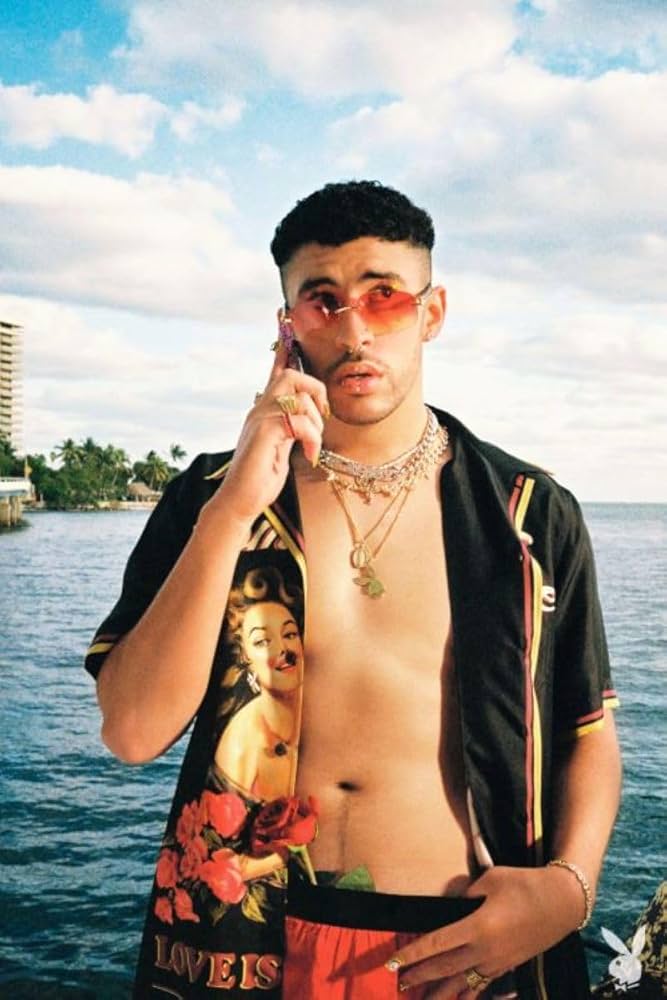
I may be asking for trouble by doing a music post that shades into politics, but I thought it might be interesting to link to some Bad Bunny videos. Quick précis: Bad Bunny is the stage name for Benito Antonio Martínez Ocasio, a Puerto Rican DJ, rapper, actor and record producer. He also has dabbled in professional wrestling, which surprised me, though I shouldn’t be, given that Dwayne Johnson, John Cena and Dave Batuista have all used wrestling as a springboard. He was tapped to do the Super Bowl halftime show, and the MAGA crowd absolutely lost their shit.
If you’re looking for an illustration of “coping mechanism,” you’ll find no better example than MAGA’s reaction to Turning Point USA (TPUSA) announcing “The All American Halftime Show,” an alternative to the actual Super Bowl halftime show, airing on Feb. 8. The event doesn’t have a lineup or even a location yet. But what the far-right organization, co-founded by the late Charlie Kirk, does have is a groundswell of racist rage about the real Super Bowl halftime show, which will feature reggaeton star Bad Bunny.
This link also gives a nice rundown.
Now, the twist in the knickers is all typical MAGA pet hates, so I don’t mean to validate the shit that lives in their heads, but I thought it would be good to know who Bad Bunny is. Let’s start off with Yo Perreo Sola, which translates roughly to ‘I twerk alone’. It was listed as #1 in this Billboard article and #2 in the Rolling Stone listing
Taking in the video, after the kneejerk response, you might see more stuff the MAGA crowd can have a cow over with this guy doing the Super Bowl halftime. The gender fluidity and the sexuality would be enough, but the song itself, emphasizing female autonomy, and ending with the phrase Si no quiere bailar contigo, respeta, ella perrea sola (If she doesn’t want to dance with you, respect her, she twerks alone) is really the chef’s kiss. I think there is a lot to unpack with the visual images, what interested me was that the song is a reggeaton song. A couple of videos that got me up to speed on it
And this has more of the history, which talks about the diasporic character of Reggaeton as well as the campaigns to censor the music, which has made it a lot bigger. If you get in discussions with any folks who want to raise the issue of censorship, this can give you a little background on that.
Bad Bunny’s catalogue is huge, but I can’t resist sharing Yonaguni. It’s a lost love song, but the name brought me up short. Yonaguni is actually the westernmost island in Okinawa prefecture, and though the video wasn’t shot there (it looks like LA, but with lots of Asian references, including ramen, Tae kwon do practice and an anime finish), the song closes with Bad Bunny singing in Japanese, which seems kind of pointed cause he never sings in English (the initial MAGA sticking point, I believe). Why would Bad Bunny pick a Japanese island to have his lost love on? Well, Yonagumi actually had an empress, Sanai-Isoba:
Sanai-Isoba is a female of superhuman stature and strength; she performed astonishing feats and taught the islanders agriculture and improved ways of life. She also established her four brothers as village heads of Donanbaru, Dateg, Dannu, and Tebaru. She is said to have gone abroad to oishigaki and Iriomote, thereby initiating a cultural pattern, whereby the less advanced ust learn from their superiors, viz. the Okinawans from the Chinese, the Miyakoans from the Okinowans and so forth, isolated, marginal Yonaguni was the lowest rung on the ladder.
Interesting to me is that the English Wikipedia page has a section about Japanese ideas about the women of Yonaguni, with plausible references, but I can’t find any deeper confirmation. The name does mean ‘island of women’ and there was an exoticization of these places in Meiji, but the section isn’t mirrored the Japanese wikipedia page and seems a bit more lurid. Still, the idea that “Women on the island have white skin, and are attentive and thoughtful,” seems to be reflected in the video, so I’m wondering if that factors in.
As hinted at in Yo Perreo Sola, there is a strong feminist/anti misogynist turn in BB’s music. This one, Solo de Mí, features Venezuelan actress Laura Chimaras (almost all of BB’s videos have people who are well known in Latin America, which both indicates his popularity and cultural juice). This one is about a woman who is a victim of domestic violence, but overcomes it.
Another big theme in his work is a fierce pride in his Puerto Rican roots. In fact, his 30 day residency in PR, which brought an estimated $713 million, is another red flag for die MAGA Rotkunstt as he refused to play in the continental US, expressing concern that ICE would target his fans. The next video, for the song El Apagón – Aqui vive gente [The blackout: People live here], is so dense that I asked Gemini to give a break down.
The official video for El Apagón is not a typical music video but a powerful 23-minute short film and mini-documentary titled Aquí Vive Gente” (People Live Here). It was directed by Kacho López Mari and released in September 2022.
Part 1: The Song (Approx. [00:00] to [06:56])
The first section of the video is dedicated to the song itself, and it acts as a visual protest and a celebration of Puerto Rican culture and resilience.
- Visuals: The video captures raw, energetic scenes of people dancing, celebrating, and protesting across various parts of Puerto Rico. It focuses heavily on themes mentioned in the lyrics:
- The Blackout: Shots of people celebrating and dancing enthusiastically, often in dimly lit areas or using handheld lights, emphasizing the idea of finding joy and party (
regaetón) even amid the frequent power outages.- Protest: Quick cuts show people holding signs against LUMA Energy and corruption, reinforcing the lyric: “Let’s turn off LUMA, let them leave us alone.” [01:37]
- Culture: High-energy footage showcases street parties, people grilling, and community life in various neighborhoods, highlighting the cultural richness that the lyrics promise to protect.
Part 2: The Documentary Segment (Approx. [06:56] to End)
The music fades and the video transitions into a serious, investigative short film, primarily led by Puerto Rican journalist Bianca Graulau (whose voice is heard in the song’s outro). This segment provides context for the political and economic struggles referenced in the song.
1. Gentrification and Displacement
This section focuses heavily on how tax incentives (like Act 22/60) have led to the displacement of native Puerto Ricans in favor of wealthy foreign investors.
- Eviction Stories: The documentary features interviews with long-time residents, like Maricusa, who received 30-day eviction notices after buildings were bought by foreign companies who planned to flip the properties for much higher prices. [06:07] and [07:45]
- Real Estate Flip: It reveals that residential buildings, purchased cheap, are immediately put back on the market for millions of dollars, or converted into short-term rentals (like the story of the Ferrería building apartments). [10:41]
- Community Loss: Residents of Puerta de Tierra speak emotionally about losing their ancestral homes and community to wealthy interests, noting that they are being treated like “colonizers” in their own country. [08:00]
2. The Energy and Infrastructure Crisis
The documentary details the failures of the energy system, managed by the private company LUMA Energy.
- LUMA’s Impact: It shows the devastating consequences of blackouts on everyday life, including students doing homework in the dark and people being unable to use essential medical equipment at home. [01:17]
- Rising Costs: It highlights the consecutive rate increases for electricity while the quality of service declines, showing the irony of high executive salaries juxtaposed with poor infrastructure. [01:26]
3. The Fight for Public Spaces and Beaches
The video explores the privatization and blocking of public spaces, particularly the coastlines.
- Dorado Beach Access: The segment follows a worker, Rosa Rivera, as she attempts to access the public beach adjacent to the luxury Dorado Beach community, showing how private developments have restricted or made access nearly impossible by blocking pathways and forcing people to walk over dangerous rocks. [16:35]
- The School: It shows the transformation of a former public school (the Martiniere in Puerta de Tierra) that was closed by the government and sold to a beneficiary of the tax incentives to be converted into luxury apartments. [12:30]
- Resistance: It ends with powerful footage of activists tearing down an illegal construction fence at Sol y Playa beach, demonstrating the grassroots resistance against privatization and land grabs. [20:34]
The video intentionally concludes with the spoken word part of the song and a final shot of the Puerto Rican flag, driven home by the sound of the coquí (native frog) and a police siren, confirming that the struggle for the island is far from over.
I have just picked out a few videos with no regard to the timeline and I’m sure that a better view would be obtained by seeing his development over his career. I’ve also not spoken to his allyship with the LGBTQ+ community, which must be another big issue with MAGA types.
For some predictions from me, I imagine that BB won’t do a big gender fluid thing, what he’ll probably do is focus on Puerto Rican pride. This will still leave him with a lot of material to tweak Trump and the MAGA crowd, such as throwing paper towels during Hurrican Marie or “comedian” Tony Hinchcliffe calling PR a “floating island of garbage”
Hope that gives everyone some background. If I missed anything or folks have things to add, please do!
If I were to formulate a hunch about “Yonaguni,” I’d say that there are a few different synergies at work there. Given El Conejo Malo’s gender fluidity, we might consider how Yonaguni, as a feminine coded island holding of Japan might stand in for a similar dynamic between Puerto Rico and the US.
Of course it also lets him cross over into the Kpop and Jpop audiences while stepping around the US (and, as you note, English language lyrics). Between reggaeton and the Asian pop scenes one could really capture an international audience and maintain a US presence all without ever having to make a single move to acknowledge the US mainstream.
Well, I’ve gone from having no clue who he was to having a great deal of respect! Thank you for all the insights, LJ. That’s said, I don’t like the music. If there wasn’t a video to watch, I think the music would be repetitious to the point of boredom or annoyance–but that’s my reaction to the sound, not to BB as a person, his lyrics, or the message.
The repetitiveness of reggaeton is a feature, rather than a bug, for most fans of the genre. It’s meant for dancing to in a hot, sweaty club, or blasting in the car, or for (as my students tell me) “vibing” to as they chill or do other things. Breaks in pattern and variations distract from the vibe and demand attention.
A lot of modern popular music is meant to be a background soundtrack for the listeners’ noisy lives. It takes a couple weeks for my students to learn how to actively listen and to match speeds with music that is trying to be more than just a simple expression of a single thought or feeling, strung together in a playlist full of similar songs.
This life brought to you by The Algorithm.
Hey, that’s actually a really good breakdown of reggaeton. Clear and succint and accurate.
I am completely ignorant of Bad Bunny’s work because (a) rap leaves me behind because I have a hearing impairment that makes it basically impossible for me to make out lyrics in recorded music, and (b) reggaeton drives me nuts – it’s not just that it’s repetitive, the repeating cell is so small that there is no (to my ear) breathing room.
Plus I live near a couple of large Latin communities and the way I hear reggaeton is typically being cranked from some guy’s car at a volume level that makes the doors of my car vibrate from the massive bass. I want to take those guys aside and say “You’re gonna be stone deaf by the time you’re 40” but I’m more than sure they wouldn’t care. They’re having fun now, 40 is a long way off.
I miss salsa. At least that gives you both sides of the clave.
All of that said, BB seems like a very interest artist and social and cultural persona. I’m not a sports guy and will likely not watch the Super Bowl, but I’m both amused and delighted that he was the NFL’s pick for the half time show.
In my wildest dreams I would never have predicted the NFL as a socially forward-looking organization. I suspect they know who their viewing audience is.
MAGAs just gonna have to learn to share the world with everybody else.
MAGAs do not want to share the world with anyone else. Not sharing is the point of the movement
Nous mentioned the soundtrack by which his students live. I have the impression that people form their musical tastes early and tend to stick fairly closely for the rest of their lives.
That’s my experience. I have expanded by learning new artists, but the sound is all in the country/rock/folk/blues range.
It seems bizarre now but when I was in high school, parties consisted of groups of young people in someone’s apartment near campus, stoned and silent while listening intently to music. That’s how I heard Abraxis, Abbey Road, American Beauty, Volunteers.
The idea of getting together at someone’s home to listen to records seems utterly incongruent now.
Times change.
I was standing in the grocery the other day when I heard Mick Jagger wailing, “You’re enough to make a dead man come!” And I thought, “In about ten years, that will be nursing home music.”
or for (as my students tell me) “vibing” to as they chill or do other things. Breaks in pattern and variations distract from the vibe and demand attention.
When I was in college I had what my housemates called “Mike’s math tape”. Everything on it was loud, 4/4 time, muddled lyrics. I dug it out and put on the headphones when I had to do math proofs or work through complicated bits of code. Reputedly, the housemate who had taken it upon himself to manage my social life once told a female friend of mine on the phone, “No, you can’t talk to him. He’s in there with the math tape on, covering page after page in that cramped little handwriting. You could parade through naked and he wouldn’t notice.”
Similar to Mike’s Math Tape, I wrote most of my dissertation while playing a mix of albums from A Beautiful Machine, which was all washed out, ambient, shoegaze-y sounding post-rock. It was noisy enough to drown out distractions, flowy enough to not get monotonous, and indistinct enough that the lyrics wouldn’t interfere with whatever complex thought it was I was trying to work out in words.
https://abeautifulmachine.bandcamp.com/album/home
It was my most played music for three years and for 247 pages worth of obsession, stress, and isolation.
I was standing in the grocery the other day when I heard Mick Jagger wailing, “You’re enough to make a dead man come!” And I thought, “In about ten years, that will be nursing home music.”
LOL.
I have expanded by learning new artists, but the sound is all in the country/rock/folk/blues range.
It sounds like our tastes are quite similar, wonkie, (even down to those same albums among others) although I admit I came to country pretty late, and still not to the same extent as the other categories. Folk was probably first, then rock, and of course the latter was heavily influenced by blues. I have never been able to get into rap, and this post is the first I’ve heard of reggaeton; I’m not crazy about it.
MAGAs do not want to share the world with anyone else. Not sharing is the point of the movement
They are in for a big disappointment, because the rest of the world isn’t going away. And it’s true, they’re trying to make the US their own private homogenous playground, but there are too many other kinds of people here already. A lot of us were born here.
A lot of the brown Spanish speaking people were here before this country was.
I don’t know what it’s gonna take for these fuckers to get it through their heads that white skin and blue eyes just ain’t that big of a deal.
Fun stuff everyone. Just to pull out a few things
I miss salsa. At least that gives you both sides of the clave.
My playing experience has been classical and ‘big band’ jazz (by which I mean the size of the ensemble, rather than the swing bands that people think of) so my Latin experience is pretty minimal, but I did have a section in the post about the clave’s evolution to reggaeton, but it is 1) hard to explain about rhythms and 2) I’d probably screw it up. This first article on this page might be of interest for folks wanting more
https://www.cubanet.org/htdocs/CNews/y00/jun00/12e9.htm
Yonaguni, as a feminine coded island holding of Japan
I wasn’t able to find any interviews with BB talking about the song and how it came about, so I imagine it was a mélange of reasons.
one could really capture an international audience and maintain a US presence all without ever having to make a single move to acknowledge the US mainstream.
I’ve recently been getting youtube videos titles [Indian journalist/Singaporean minister/Chinese author] destroys [Western journalist/politician/pundit]. and one of the lines that always seem to score points is the first person calmly pointing out that the West is about 15% of the world while Asia is about 60%.
This life brought to you by The Algorithm.
I wonder if there is a chicken-egg thing going on here. The trends mentioned by nous have been in popular music since the 50s, before the tech-bros had gotten their hands on the internet. I don’t want to absolve them of their responsibility, but I don’t want to give them too much credit for the idea, more of the shitty implementation.
I also think that these Weekend Music threads, because of my own interests, are going to lean into how so much music is blended and remixed. It’s not new, classical music has a long tradition of taking folk melodies and rhythms and repackaging them, but I’m beginning to think that this is really foundational. So if that sounds boring, guest Musical weekend threads are solicited!
This first article on this page might be of interest for folks wanting more
Ai, rumba!! Allow me to digress.
Rumba in its various forms is / are kind of folkloric root and base of Cuban music. This right here is guaguanco, one of the three traditional rumba styles, and the one most commonly still performed, played here in pretty much it’s traditional form.
https://www.youtube.com/watch?v=LOQvzI1A2P0
Another guaguanco, with the great Orlando “Puntilla” Rios, grand old man of the Cuban / New York rumbero community. The clave is easier to hear here, it’s more even eighth notes, where the more traditional players tend to elide the difference between a duple and triple time feel. This is *rumba* clave, a little different to the “Bo Diddley” “shave and a haircut” clave – called *son* clave – shown in the reggaeton in two minutes clip.
This is one of my favorite videos in the world. When they break into the call-and-response thing at about 4:30 and the dancers get up the joy of it all is palpable.
https://www.youtube.com/watch?v=DnBN_AXfkvk
Salsa is more of a popular, dance club style, mostly based out of New York. Here is the great Ruben Blades performing “Pedro Navaja”, which is basically the Spanish version of “Mack the Knife”. This has son clave, which you can hear pretty clearly at the beginning of the tune.
https://www.youtube.com/watch?v=TqCC-zWQfdI
Clave is the key (literally) to a really broad range of musical styles and traditions of the Spanish-speaking African diaspora. It’s one of many similar rhythmic patterns found in Africa, all of which turn out to be Euclidean rhythms, which I will not get into because we’ll be here all night.
I pretty much love Latin music.
Russell, if it is ok, I’d like to lift up your comment as next week’s music thread?
Absolutely
A little late, but this Daily Show explainer on Reggaeton is good
https://www.youtube.com/watch?v=4rdNWZXFREA
Since this is a music thread:
Is someone here able to transcribe the lyrics of this song for me?
https://www.youtube.com/watch?v=gJgDp5zF4s0
I only get disconnected fragments and the auto captions produce mostly rubbish.
Hartmut, a best guess
====
In [Venice]
Rollers [ahead]
It’s so full of fun
While you roll, you feel the groove
Such a sport that makes you move
Grandpa
and mama too
Freaks are all the same
police chief and businessman
They are rolling
They are rolling
to the holy land
Roll
Roll
Roll on baby roll x2
skating here in the rolling disco
Lights are blinking wild
exotic clothes and bathing suits
skintight is a style
repeat chorus
Mama’s rolling with a baby on her back
Just moving like the wind
headphones upon her ears
full of power
full of power
There’s a crazy [??]
repeat chorus
Thank you, lj.
Let’s see whether the last few gaps can be closed still.